
Biodiversity is more than a scientific concept and environmental buzzword—it is the foundation of healthy forests, clean water, and resilient landscapes. Protecting biodiversity begins with protecting the landscapes that sustain it. Northwest Connecticut Land Conservancy (NCLC) safeguards a network of conserved lands and public preserves, totaling 14,400 acres (and growing). These lands protect habitats that support approximately 55 species of Greatest Conservation Need and 14 State Assessment Priority Species identified by Connecticut’s Wildlife Action Plan.
Rare species can serve as bioindicators, signaling the health of an ecosystem. Changes in hydrology, topography, land management, climate, or invasive species encroachment can alter ecosystem diversity and overall function.
In one area in particular, NCLC-protected land within a 300+ acre wetland system in Northwest Connecticut is supporting 16 of Connecticut’s Species of Greatest Conservation Need, including one federally threatened species. Among these is state-endangered scarlet paintbrush (Castilleja coccinea), once widespread across New England but now found in only a few locations in the Northeast and one known location in Connecticut.
Scarlet paintbrush is a hemiparasitic biennial plant and needs a host plant to complete its life cycle. Host plants can include a wide variety of species, including grasses and wildflowers. It grows well in early successional habitats with full sun and disturbance, such as hayed meadows and powerline cuts. Sometimes confused with hawkweed (Hieracium spp.) and cardinal flower (Lobelia cardinalis), similarly eye-catching wildflowers that grow in similar conditions, scarlet paintbrush grows 9 to 24 inches tall and produces small greenish flowers with showy scarlet bracts, typically in May in Connecticut.
Historically, scarlet paintbrush covered acres of a wet meadow landscape in Connecticut. The population dwindled over time until a single flowering stem was observed in 2023. Although flowering plants were not observed for the following two years, seeds from scarlet paintbrush were believed to still be viable in the soil’s seed bank. To test this theory, in 2025, NCLC partnered with Heather Liljengren of Local Land Consulting to develop experimental germination plots that mimic disturbances that may have historically influenced the plant’s life cycle. In the fall, dethatching and low-intensity burn applications were applied to 10 experimental plots, with surveys scheduled to observe the results the following year.
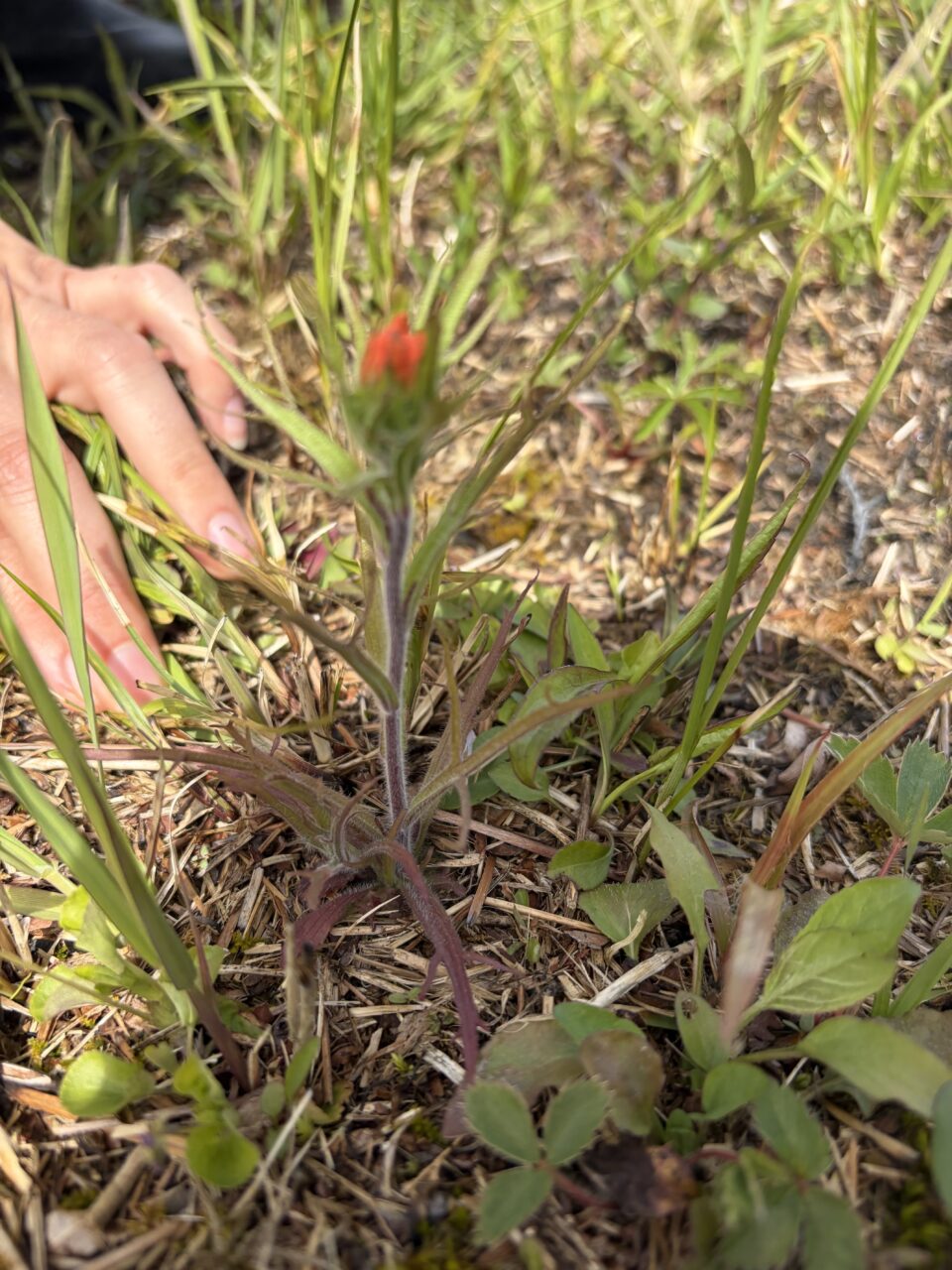
Initial monitoring has shown promising results. On April 29, 2026, a single flowering stem was observed in one of the experimental plots, offering hope for the restoration of this population and valuable insights into potential future management practices. NCLC will continue to work with partners to develop stewardship practices that support the long-term survival of this critical population.
Protecting biodiversity requires more than protecting land alone—it requires long-term habitat stewardship, scientific collaboration, and a shared commitment to caring for the landscapes that sustain life. By supporting NCLC, you help protect critical habitats and safeguard rare species for future generations. Together, we can ensure that the forests, wetlands, rivers, and working lands of Northwest Connecticut continue to support the extraordinary diversity of life that makes this region unique.
To learn more about scarlet paintbrush and its restoration, check out the frequently asked questions below.
FAQs
Question: There seem to be yellow- and red-flowering varieties of scarlet paintbrush. Are they the same or different species?
Answer: The scarlet paintbrush native to New England, Castilleja coccinea, is primarily red and rarely yellow. There are different species of Castilleja that exhibit flowers in shades of red, orange, yellow, pink, and white.
Question: Should I be planting scarlet paintbrush? Where can I get seeds?
Answer: The restoration of this species in Connecticut and areas where it has disappeared and is endangered is best done with professional assistance. Scarlet paintbrush is a rare and highly specialized hemiparasitic plant, and it depends on host plants, specific habitat conditions, and environmental regimes to survive. Because many commercially available seeds originate from genetically different western populations, Northeast restoration efforts prioritize protecting and encouraging locally adapted New England genetics whenever possible. Longer-term survival depends not only on planting seeds or plants, but also on active habitat stewardship.
When purchasing seeds, caution should be exercised to ensure they are from the local ecotype where they will be planted. There is currently not a Northeastern ecotype of Castilleja coccinea available on the market. It is also important to note that collecting seeds and plants of state-listed species is prohibited on state and private property without a proper state permit.
Question: Do you have more information on where scarlet paintbrush naturally grows and the methods and plot treatments used to get seed to germinate where it had previously been extirpated?
Answer: Scarlet paintbrush primarily grows in early successional habitats with open, sunny, and mesic environments. It is often found growing in calcareous fens, damp meadows, prairies, and fields. Historically, scarlet paintbrush responded well to several types of disturbances, including but not limited to haying, burning, and grazing. Local Land Consulting developed the restoration management plan for this site, guiding NCLC through targeted dethatching and low-intensity burn applications in the areas where scarlet paintbrush was once known to thrive. NCLC is monitoring the plots to assess the seed bank’s response.
Question: If I have scarlet paintbrush or a rare species in my yard, is there someone to report them to?
Answer: Flora and fauna species of all kinds can be reported on iNaturalist, an online community science database. However, protection of rare and endangered species varies by state, and specific state guidelines for reporting should be followed. Contact your state Department of Environmental Protection for guidance. In Connecticut, state-listed species can be reported by citizens to the Connecticut Department of Energy & Environmental Protection’s Natural Diversity Data Base.